TRAINHARD4LIFEllc
To Give You The Fitness And The Knowledge To Perform Your Best.
Off Season? by Mike Olheiser
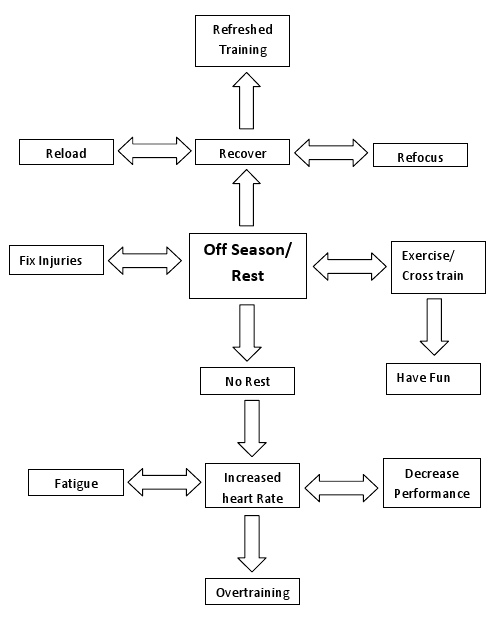
So if you are like me, you have been reading all kinds of articles on what to do and what not do during the off season (I’ll call my reading “research” so you don’t have to read the same articles). First of all, you need rest, mental and physical. Need some convincing? Keep reading.
Off Season Checklist
1. Don’t stop exercising.
2. Have fun.
3. Recover.
4. Refocus.
5. Reload.
6. Look toward next year.
Sounds simple, right? The breakdown:
Don’t Stop Exercising
Do change the routine. Cross train; strength train, run, bike, trail run, mountain bike and decrease your workload. Have fun with your exercise.
Recover
Your off season should be used to break yourself of a routine, i.e., stop cycling or stop running, give your body some time to recover from any injuries and rest tired and sore muscles. If you do not have injuries the transition will be even easier. If you have nagging injuries find out why they won’t go away and give them time to rest and fix them. If fixing it means you need to add resistance training, add it. If your injury is due to overuse, slow down or stop for a while. You can still do some intensity, but not at the same volume you do during regular training.
Refocus
Use this time to refocus on what is important to you. Go spend time with your significant other or maybe find a significant other. Use this time for activities you enjoy and enjoy the time without a focused routine.
Reload
Use your off season as a transition period. Reestablish goals, find what motivates you, and make a plan for next year. Then write it down and make it happen.
Off Season Checklist
1. Don’t stop exercising.
2. Have fun.
3. Recover.
4. Refocus.
5. Reload.
6. Look toward next year.
Sounds simple, right? The breakdown:
Don’t Stop Exercising
Do change the routine. Cross train; strength train, run, bike, trail run, mountain bike and decrease your workload. Have fun with your exercise.
Recover
Your off season should be used to break yourself of a routine, i.e., stop cycling or stop running, give your body some time to recover from any injuries and rest tired and sore muscles. If you do not have injuries the transition will be even easier. If you have nagging injuries find out why they won’t go away and give them time to rest and fix them. If fixing it means you need to add resistance training, add it. If your injury is due to overuse, slow down or stop for a while. You can still do some intensity, but not at the same volume you do during regular training.
Refocus
Use this time to refocus on what is important to you. Go spend time with your significant other or maybe find a significant other. Use this time for activities you enjoy and enjoy the time without a focused routine.
Reload
Use your off season as a transition period. Reestablish goals, find what motivates you, and make a plan for next year. Then write it down and make it happen.
Training on the Trainer, Do’s and Don’ts
Do’s Don’ts
Workout with structure Tell yourself you can sit for
including one leg intervals. two hours watching Landis tear
everybody’s legs off in the
2006 TOF Stage 17.
Work on spinning and efficiency: Sit and talk on the phone to your bff
RPM’s greater than 100. .
3 to 5 minute intervals working Sit in a wet chamois for three hours.
high end power output. Change your drawers.
Try to imitate Lance in Time Trial Let yourself get dehydrated and run
position and beat him to the finishing out of energy on a 2 hour session.
Stretch.
Plan your workout to get the most Forget to stick to your plan.
of your time and make your time
count.
Do’s Don’ts
Workout with structure Tell yourself you can sit for
including one leg intervals. two hours watching Landis tear
everybody’s legs off in the
2006 TOF Stage 17.
Work on spinning and efficiency: Sit and talk on the phone to your bff
RPM’s greater than 100. .
3 to 5 minute intervals working Sit in a wet chamois for three hours.
high end power output. Change your drawers.
Try to imitate Lance in Time Trial Let yourself get dehydrated and run
position and beat him to the finishing out of energy on a 2 hour session.
Stretch.
Plan your workout to get the most Forget to stick to your plan.
of your time and make your time
count.
Reasons not to Exercise with Injuries.
1. Injuries need time to recover, that is probably why the injury is there in the first place. Pain from an injury is probably telling you something:
a. Muscles are out of balance.
b. The body needs rest.
c. Time to evaluate training.
d. Rethink activities or find cause of pain or injury .
2. Injuries can decrease performance and make exercise painful. It is not a rite of passage.
3. Continued stress on an injured area can:
a. Prolong recovery.
b. Cause more damage to effected area.
c. Become chronic and end a season, career, or last a life time.
d. Damage unaffected areas by changing movements and effect normal gait.
Things you can do to Prevent injuries.
1. Get proper rest, both with activities and sleep at night.
2. Make sure your equipment is working properly i.e., shoes are not worn out or an incorrect bike fit.
3. If you feel something is not right have it check by somebody who is an expert.
4. Address pain as it comes and decipher between good and bad pain.
5. Have somebody build a program around your goals, ambitions, and time.
1. Injuries need time to recover, that is probably why the injury is there in the first place. Pain from an injury is probably telling you something:
a. Muscles are out of balance.
b. The body needs rest.
c. Time to evaluate training.
d. Rethink activities or find cause of pain or injury .
2. Injuries can decrease performance and make exercise painful. It is not a rite of passage.
3. Continued stress on an injured area can:
a. Prolong recovery.
b. Cause more damage to effected area.
c. Become chronic and end a season, career, or last a life time.
d. Damage unaffected areas by changing movements and effect normal gait.
Things you can do to Prevent injuries.
1. Get proper rest, both with activities and sleep at night.
2. Make sure your equipment is working properly i.e., shoes are not worn out or an incorrect bike fit.
3. If you feel something is not right have it check by somebody who is an expert.
4. Address pain as it comes and decipher between good and bad pain.
5. Have somebody build a program around your goals, ambitions, and time.